
Resources Guide
Strengthening Our Impact:
This resource guide was created by immigrants for immigrants to identify resources during these tough times for Immigrants and Refugees across the state of Nevada. Here you can find specific information on access and resources for those with sensitive immigration status.
Get in touch!
For information about this guide, contact the Progressive Leadership Alliance of Nevada at (775) 348-7557 or by email at [email protected] or Make the Road Nevada at [email protected].
Everyone in the U.S. has certain rights guaranteed under the U.S. Constitution, regardless of their immigration status. See section titled “Know Your Rights.”
Several organizations, churches, and community spaces offer food and supplies available regardless of immigration status. See the section titled “Food and Basic Needs Assistance.”
There are options for obtaining financial assistance. See the sections titled “Financial Assistance” and “Utilities” for more information.
There are options for low-cost legal immigration assistance. See the section titled “Legal Assistance.”
Donate
Your contribution helps fund essential services and programs for our community.
Become a Volunteer
Join us by volunteering your time and skills to create a greater impact.
Advocate
Use your voice to support policy changes and promote social justice.

Know Your Rights
Basic Constitutional Protections
- Right to Remain Silent: You have the right not to answer questions about your immigration status, place of birth, citizenship, or method of entry into the country. Anything you say can be used against you in immigration proceedings.
- Right to an Attorney: You may request to speak with an attorney at any time. In criminal matters, if you are arrested by law enforcement, you have the right to a government-appointed attorney. In immigration proceedings, you have the right to consult an attorney, but the government is not required to provide one. Ask for a list of free or low-cost alternatives. If you have no lawyer, ask the court to allow you time to find one.
- Protection Against Unreasonable Searches: Officials may not search you or your belongings without your consent or a judicial warrant based on probable cause.
- Home Privacy Rights: U.S. Immigration and Customs Enforcement (ICE) agents or other federal agencies providing support to immigration enforcement (FBI, ATF, DEA, etc.) need a valid judicial warrant to enter your home. A deportation order alone does not grant entry without your consent.
Learn about the many resources we have for you

Encounters with Immigration Agents
- In most circumstances, you are not required to open the door for ICE if they don’t have a judicial warrant. A Judicial warrant is a document that is signed by a judge. You can speak through a closed door with ICE.
- Ask them to slide the warrant under the door or hold it up to a window. Verify that it bears your correct name, address, court name, and a judge’s signature.
- You have the right to remain silent and not answer any questions.
- You have the right to refuse consent to a warrantless entry into your home.
- You have the right to speak with an attorney.
- You have the right not to sign any document that you do not understand. Even if the ICE officers are persistent and want to pressure you, do not sign.
- You can ask the officers if you are being detained; if you are not, then you are free to leave.
- Do not physically resist a government official, and do not run away.
- You have the right to remain silent, not answer any questions, and request to speak with an attorney.
- ICE needs employer permission (consent) or a judicial warrant to enter non-public areas of work premises.
- Employers can watch the agents and see if they are complying with what’s written in the judicial warrant, if one was provided.
- You may record interactions with agents as long as you do not interfere with their duties.
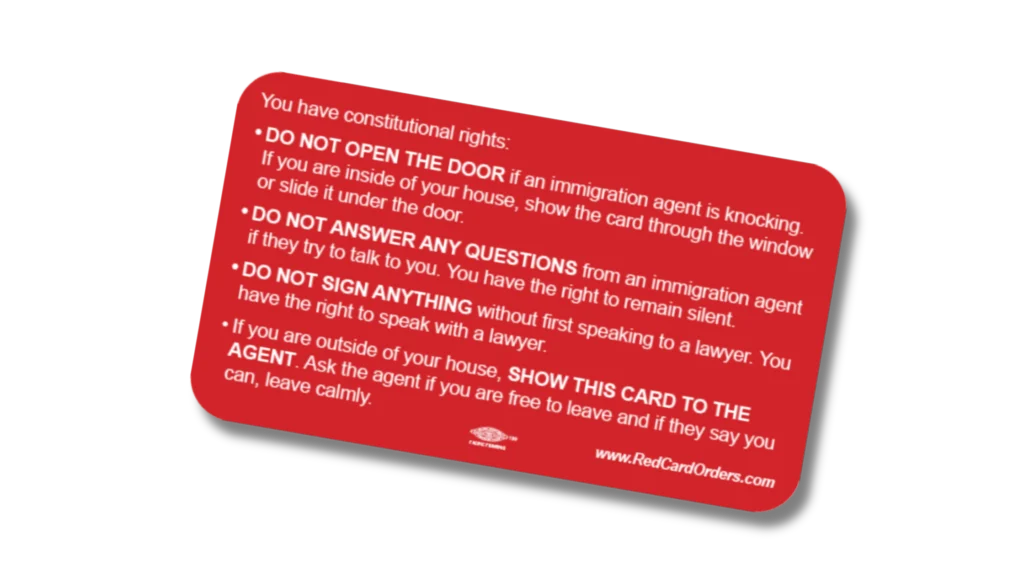
Red Cards:
- Always carry the card in your wallet or pocket.
- If stopped in public, hand the card to the agent. If at home, show it through a window or slide it under the door.
- Handing a red card to an officer may not be enough to protect your rights. Verbalizing your rights may still be needed to protect yourself.
- Red Cards are available in multiple languages.
Documents You Should Carry:
- If you are not a U.S. citizen and an immigration agent requests your papers, you must show them if you have them with you. If you are over 18, carry your immigration documents with you at all times. If you do not have immigration papers, say you want to remain silent and that you want to consult a lawyer before answering any questions.
- Proof of residence if you’ve lived in the U.S. for more than two years (rental agreements, school records, mailed correspondence).
- Memorize your A-Number (immigration case number) and keep documents with your A-number in a safe place.
Documents to Avoid:
- Never present false documents to law enforcement or immigration agents.
- Do not carry documents issued by foreign countries.
Family Emergency Plan
Advance Planning:
- Prepare a family emergency plan including contact information, essential documents, and care instructions for your children.
- Designate a trusted contact who can act on your behalf in the event of an emergency.
- Keep copies of crucial documents with trusted individuals.
Emergency Information
- Memorize key phone numbers for attorneys, family members, and your consulate.
- Prepare childcare authorization forms naming a caregiver for your children.

What to Do If Your Rights Are Violated?

Document the Incident
- Write down everything you remember, including officers’ badges and patrol car numbers, which agency the officers were from, and any other details. Get contact information from witnesses.
- If you’re injured, seek medical attention immediately and take photographs of your injuries.
- File a written complaint with the agency’s internal affairs division or civilian complaint board. In most cases, you can file a complaint anonymously.
Reporting Violations
- Contact your attorney to incorporate the incident into your case.
- File complaints with the agency’s internal affairs divisions.
Special Considerations
Lawful Permanent Residents (LPR)
or Green Card Holders
You have the right not to sign any document that you do not understand. Never sign documents relinquishing your LPR status without legal counsel. Only an immigration judge can revoke your green card.
Deferred Action for Childhood Arrivals (DACA) Recipients
If your DACA expires soon, you are encouraged to apply for renewal. Currently, USCIS suggests filing a renewal request between 120 and 150 days (i.e., between 4 and 5 months) prior to the expiration of your DACA. USCIS will accept forms before 150 days, but it may not process them until your DACA is within 150 days of expiration. There is currently no deadline by which renewal requests are due. However, it is possible that a court could order USCIS to stop granting renewal applications in the future. If you are thinking about renewing earlier than 150 days in advance, we recommend that you consult with an immigration attorney or accredited representative before filing your renewal early.
As a safety measure, we recommend carrying a valid work permit at all times.

Key Reminders:
- Remain calm and do not run if you encounter ICE.
- Never lie about your status or use false documents.
- Do not sign anything before consulting an attorney.
- Exercise your right to remain silent.
- Prepare your family with an emergency plan and essential contacts
- Always carry your Red Card and valid documents.